
Marshall County Criminal Docket Searches
Marshall County offers no free, open name-search page of its own. Remote readers can pay for the Alacourt.com trial-court service. Or buy single-case access through Just One Look. For free electronic viewing, use the public-access computer in the Guntersville Circuit Clerk's Office. Phone works too. Call the clerk at 256-571-7785 and choose option 3 for District Criminal. Choose option 4 for Circuit Criminal. Bring the full case number and the defendant's exact name spelling, and any search goes faster.
AlaFile serves registered filers, not anonymous readers. When a record fails to show up remotely, contact the division. Do not assume the Marshall County criminal case never existed or has ended. Older material and restricted cases may need in-person inspection. Files without images may need a targeted copy request.
- Decide whether the matter is District Criminal, Circuit Criminal, or a city case.
- Use the full SJIS number when possible, including the county, case category, year, sequence, and extension.
- Choose paid remote access, the free Guntersville terminal, or the correct clerk phone option.
- Read actions in date order, checking charges, pleas, settings, rulings, and disposition separately.
- Ask the Circuit Clerk for the signed order when the docket index alone is not enough.
Note: No official Marshall County source promises a real-time refresh. Confirm any near-term setting directly with the correct criminal division.
Marshall Criminal Docket Court Split
A felony can move through two docket stages. It starts in Marshall County District Court for preliminary proceedings and grand-jury presentation. Once indicted, it shifts to Marshall County Circuit Court on the Circuit Criminal track. District Criminal also keeps county misdemeanors from outside city limits. That docket includes worthless-check matters, conservation cases, Revenue Commission cases, and ABC violations. A misdemeanor inside a city usually stays with that municipal court unless a felony tags along. State court can take it on another valid basis. The official District Criminal page explains the first docket stage and why it matters.
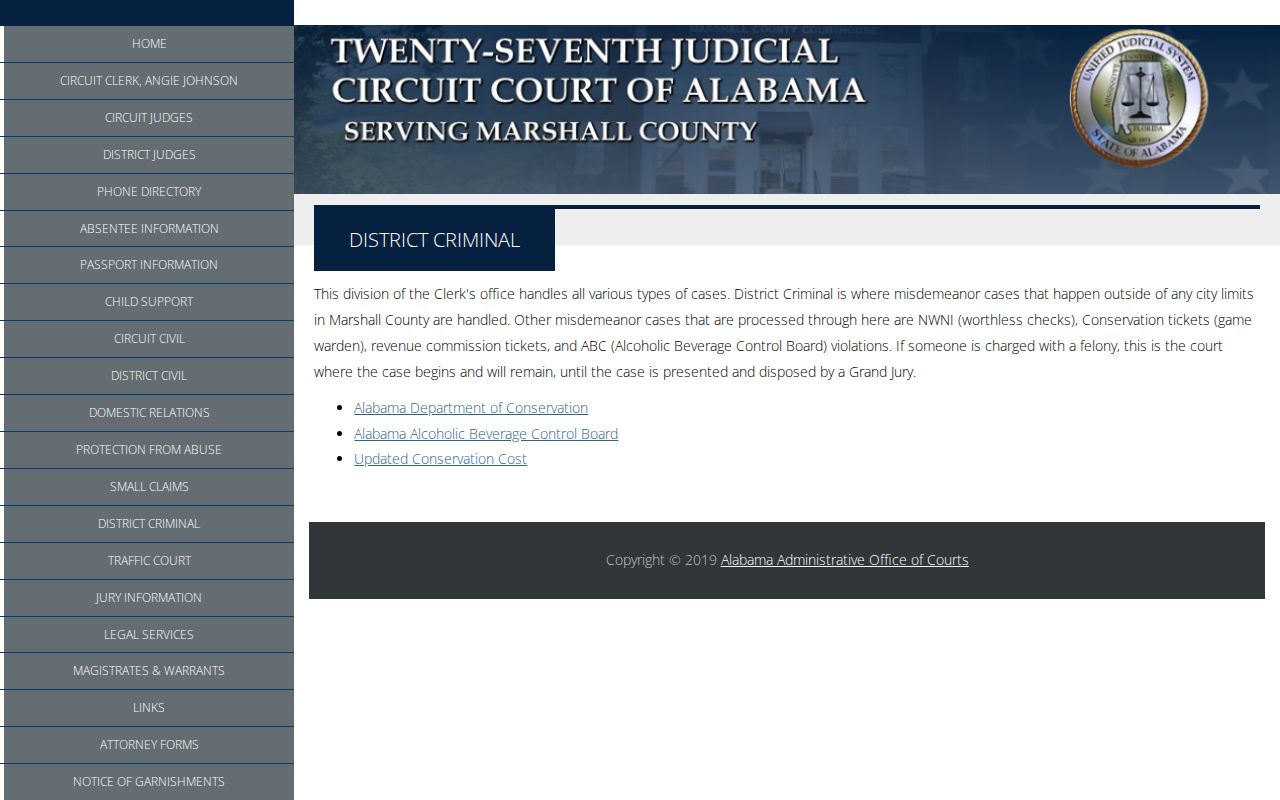
That division description keeps a searcher from hunting only for a Circuit record before any indictment exists. The official Circuit Criminal page names the later felony division.
Watch for cues. A notice reading indicted, transferred, or appeals means you should search both the originating and the receiving Marshall County criminal dockets.
Criminal Dockets: What They Show
A Marshall County criminal docket is a case-action index. It is not a complete set of filed papers. The header usually lists the SJIS number, court, judge, case category, filing date, and status. Deeper layers may add parties and lawyers, charges with statutes, and bond information. They can also add dated actions, settings and resets, rulings, disposition, costs, and whatever images that access level allows. What you can see depends on your account or terminal, the case type, and confidentiality rules.
| Case number | Marshall begins with county code 50; DC marks District Criminal and CC marks Circuit Criminal. |
|---|---|
| Charge | The offense, statute or class, and later amendments should be read as separate entries. |
| Plea and bond | The response to the charge and any release conditions; neither is the final result by itself. |
| Settings | Arraignment, pretrial, plea, trial, or sentencing dates, including later resets. |
| Disposition | The recorded outcome and date, with the signed order controlling when exact terms matter. |
A document-image link may open the paper behind an entry. A certified copy is something else: the Circuit Clerk authenticates it as a true court record. When an official copy must back a docket entry, the broader Marshall County court case records process applies.
Marshall Criminal Docket Terms
Three entries get read as one result far too often. They are not the same. A plea is the accused person's answer to a charge. A setting is just a date or event in the case. Sentencing follows a conviction or qualifying plea. It sets the court's terms. Never treat a pending filing, an old charge, or a plea line as a final judgment. Check the later entries and the signed order first.
- Indictment
- The grand-jury charging instrument that moves a felony into Circuit Court.
- Arraignment
- The proceeding where the charge is stated and a plea is received.
- Reset
- A docket event that moves a set proceeding to another date.
- Disposition
- The recorded outcome, such as conviction, dismissal, or acquittal.
- Capias or warrant
- Court process directing arrest or appearance; status must be confirmed with the court.
The Marshall County magistrates and warrants page is the county's official source for that process.
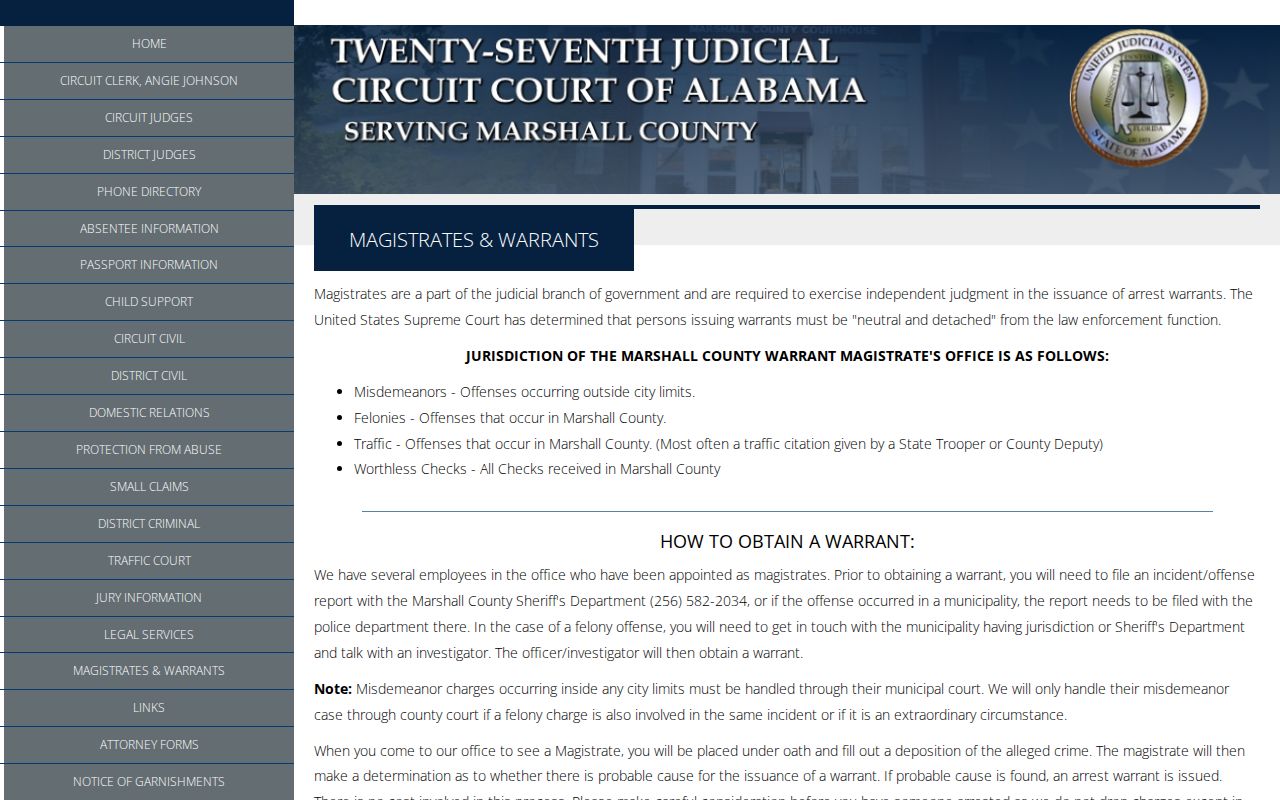
Its limits matter. A criminal docket search can explain process, but it will not tell you a warrant's present status.
Criminal Case Stages on the Docket
Read a Marshall County criminal docket from the earliest valid entry forward. A complaint or other charging step may open the District Court record. From there the docket can show service of process, bond, arraignment, motions, and preliminary settings. A grand-jury indictment pushes a felony into the Circuit Criminal docket. Pretrial motions and settings come next. Then comes a plea or trial, a disposition, and sentencing when it applies.
Docket flow: Filing › Arraignment › Pretrial › Plea or Trial › Disposition › Sentencing
The flow promises nothing about any single case. A dismissal can end a charge early. An amended charge can change what shows up later. A reset swaps one date for another without dismissing anything. If the action list simply stops with no clear disposition, call the proper Marshall County criminal division and ask whether the case moved, is still pending, or has a later order your access channel does not show.
Marshall Criminal Docket Warrant Limits
An unserved arrest warrant stays out of public view under local magistrate guidance. A blank search result proves nothing either way. Treat that carefully. A warrant line on an old Marshall County court docket is not evidence that the warrant remains active, so confirm with the court or the law-enforcement office that holds the process. For misdemeanor warrants, the magistrate window is Tuesday, 8:00 a.m. to 3:00 p.m., and issuance carries no charge.
Call the Marshall County Sheriff's Office at 256-582-2034 for incidents in the county; for an incident inside a city, use that city's police department. Police reports sit apart from the court docket. They may launch a case, but the Marshall County criminal docket records what the court actually did. Keep the report, the warrant, the charging paper, and the disposition in their separate layers.
Note: A criminal charge and a conviction are distinct events; only the later disposition and controlling order establish how the court resolved the charge.
Marshall County Criminal Docket Courts
One office holds most of the paper. The Circuit Clerk of Marshall County keeps the criminal files for both courts. That covers Circuit Court and District Court alike. District Court takes county misdemeanors outside city limits. It also handles the early stage of felony cases. Circuit Court holds felonies after indictment. Municipal clerks keep city ordinance and municipal traffic dockets on their own. Probate matters sit with the Probate Office. Those never belong in a normal Circuit or District criminal docket search.
Marshall County runs two courthouses. The Guntersville clerk office sits at 424 Blount Avenue, Suite 201, Guntersville, AL 35976. The Albertville courthouse is at 133 South Emmett Street, Albertville, AL 35950. A court notice fixes which site handles your case. The free public-access computer is confirmed only at Guntersville. Do not assume Albertville offers the same terminal. Dial 256-571-7785 for the Guntersville division tree, or 256-878-4515 and 256-878-4521 for Albertville routing.
Marshall Criminal Docket Youth Limits
Public access has edges. Alabama's court-record privacy rules place juvenile legal and social records off limits. The same rules cover juvenile law-enforcement records. Juvenile fingerprint, photograph, and DNA material is protected as well. Youthful-offender records get protection too. No paid account can override these rules. The public clerk terminal will not open a restricted file.
The Marshall County Juvenile Division page identifies the local division. It promises no public docket access.
Albertville's phone menu routes Juvenile questions to option 3. Call there first, since an authorized person needs to ask what proof of eligibility or identification the office requires. A missing caption, sparse fields, or a result that leaves out protected material should never be read as a fact.
Access Rules for Criminal Dockets
The Alabama Rules of Court-Record Privacy and Confidentiality took effect January 1, 2025. Rule 104 opens inspection and copying unless a law, rule, or court order says otherwise. Rule 401 then guarantees no-charge electronic viewing of District and Circuit records at the clerk's office during normal business hours. The rule also recognizes remote subscriber access. Marshall County's advertised Guntersville terminal gives that rule a concrete local access point.
Key access rules:
Alabama Court-Record Privacy Rules preserve public inspection while withholding sealed, confidential, and restricted records.
Ala. Code §15-27-6 addresses the effect of a criminal expungement order.
Rule 33, Alabama Rules of Judicial Administration governs statewide electronic court data while preserving clerk-office inspection.
Expungement deserves precision, not shorthand. The official Alabama expungement source shows why a person cannot simply claim the case never existed.
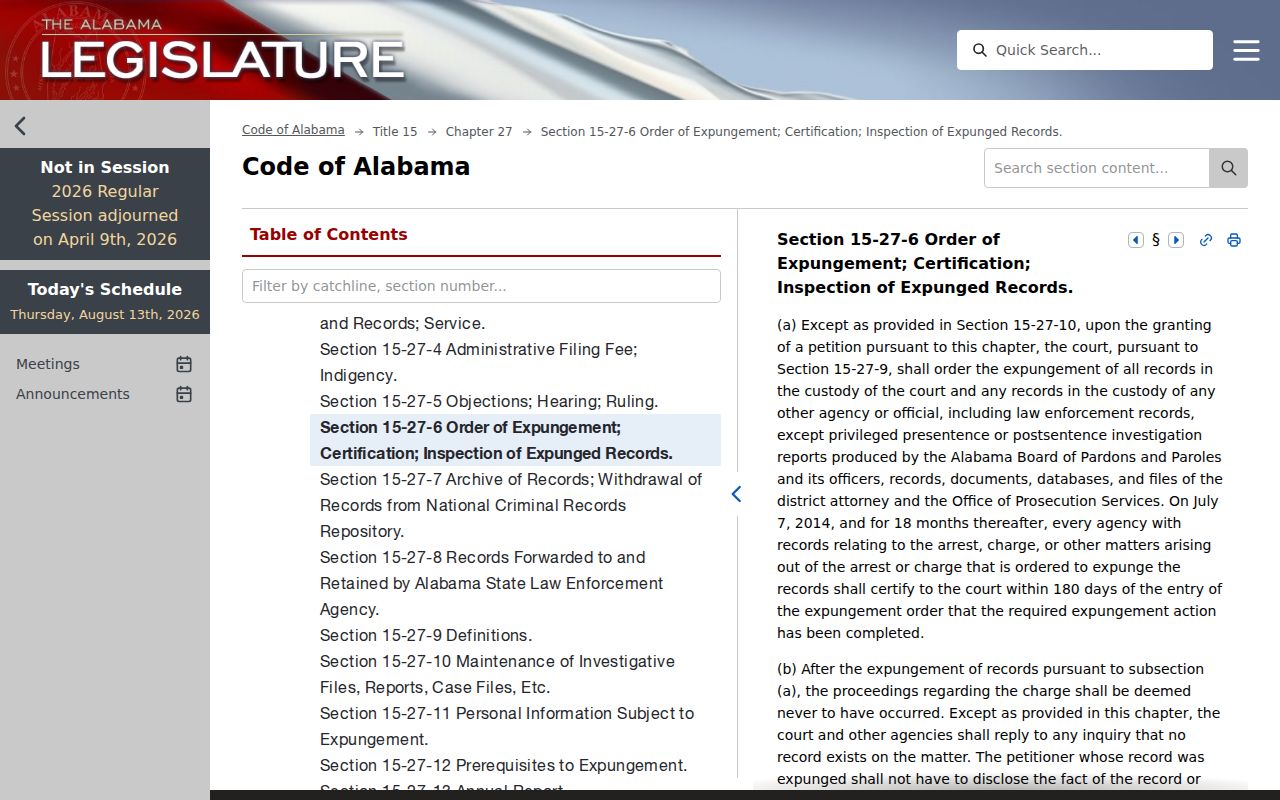
Let the returned docket and the actual order control what you say. Sealed, expunged, victim-confidential, grand-jury, and other protected information requires the court's rules plus any order governing access.
Marshall Criminal Docket Final Orders
A case-action summary points you toward the result. It does not always spell out every term of a ruling or sentence. Work in order. Begin with the latest charge or amendment. Then locate the plea, the disposition date, and the sentencing entry. When the exact result matters, name the signed disposition or sentencing order by title and date. Ask the Circuit Clerk whether an image exists. Ask also whether a plain or certified copy fits your need.
Mailing a request? Confirm the division's current instructions before payment goes in the envelope. Include the full case number, court and division, and the exact document. Add the filing date if known, the copy type, your contact details, and return-envelope information. The clerk supplies case-file facts and explains procedure. The clerk cannot interpret the order's legal effect or advise what to file. That line leaves the final signed record as the sound source for the court's result. It is not a guess built on one Marshall County criminal docket line.