
Marshall County Court Record Requests
The Circuit Clerk of Marshall County is the office to contact. That is true for Circuit and District Court files. The county offers no dedicated copy-request web form, email channel, fax route, drop box, or posted turnaround promise. It also sets no local identification rule. So name the exact file first. Then ask the division that holds it for its current instructions.
- Identify the court, division, full case number, case style, and document title or filing date.
- Inspect case details through Alacourt.com, Just One Look, or the free Guntersville terminal when useful.
- Call 256-571-7785 or use the clerk counter to confirm availability, access eligibility, copy type, price, and payment.
- For mail, use Circuit Clerk, 424 Blount Avenue, Suite 201, Guntersville, AL 35976 unless the division directs otherwise.
- State whether the copy should be plain or certified, the number of copies, delivery method, contact details, and return-envelope information.
Phone and counter contact still matter. An old, non-imaged, restricted, or hard-to-identify record usually cannot be resolved from a distance. Staff can share case-file facts. They can also walk you through procedures. What they cannot do is recommend filings or interpret what a docket entry legally means.
Three Marshall County Record Layers
A Marshall County record request works best when it names the layer you want. The case-action summary is simply a chronological index of the docket. An image is different. It is the actual pleading, notice, or order tied to a docket entry. A certified copy is different still: the clerk authenticates a reproduction of the filed original.
| Layer | What it provides | Best source |
|---|---|---|
| Case Action Summary | Actions, settings, rulings, status, parties, and costs shown in case details | Alacourt, Just One Look, terminal, or clerk |
| Document image | The filed paper behind an action when an image is available | Remote service or clerk copy |
| Certified copy | An authenticated copy for a purpose requiring clerk certification | Circuit Clerk after fee confirmation |
Remote access often answers a research question, yet it never supplies an official copy. Certification works the other way around. Name the specific filed document rather than asking the clerk to certify an entire topic, since the clerk must point to one original.
Kinds of Court Records
The unified clerk holds the full range of case files: Circuit Court felony, major civil, and domestic-relations matters, plus District Court misdemeanor, preliminary-felony, state traffic, small-claims, district-civil, juvenile, and child-support cases. What the public can see varies by category.
- Case-action summaries and docket entries
- Complaints, petitions, answers, motions, and service returns
- Notices of setting, orders, judgments, and dispositions
- Available criminal charge and civil claim information
- Financial assessments and available document images
- Certified or plain clerk copies of eligible filed records
Municipal clerks keep the city ordinance and municipal traffic records. Estates, guardianships, adoptions, and other probate records belong to the Probate Office. Transcripts are different: the court reporter makes those, not the Circuit Clerk.
Writing a Marshall County Copy Request
Write a Marshall County copy request so staff can locate one record without guessing. Include the requester's name, mailing address, and phone or email. Add the full case number, case style, court and division, document title, filing date, plain-or-certified choice, number of copies, and delivery method.
Ask the clerk for the total before you send any payment. Include return-envelope details when instructed. Never send cash, and do not assume a personal check is fine. The traffic division rejects personal checks in its own context. No single payment rule covers every records request.
No universal form: Marshall County publishes no dedicated copy-request form, so current division instructions control the submission and payment details.
Court Records: What They Contain
A Marshall County court case record opens with identifying fields. From there it builds a dated procedural history. Exactly which fields appear depends on the case type, account access, confidentiality, and whether images have been added to the docket.
| Case Number | The SJIS identifier, such as 50-CV-2025-900000.00, combining county, category, year, sequence, and extension. |
|---|---|
| Header | Court or division, judge, case category, filing date, and status. |
| Parties | Names and roles, plus attorneys when displayed and public. |
| Actions | Dated filings, service events, motions, notices, settings, resets, orders, and disposition. |
| Documents | Available images of pleadings, notices, and signed orders linked to entries. |
| Financials | Public costs, assessments, or balances available for the case type and access level. |
| Exhibits | Filed evidence or attachments, which may have separate custody and release limits. |
The docket is only an index. It does not prove every document can be downloaded. For a full filing, use the image link when available or ask the clerk for the exact paper.
Free Marshall County Court Record Viewing
Free viewing is built into the rules. Rule 401(A) of the Alabama Rules of Court-Record Privacy and Confidentiality gives the public no-charge access to electronic dockets and filed records at the clerk's office during business hours, subject to restrictions. Marshall County also advertises a public computer in the Guntersville Circuit Clerk's Office.
Circuit Clerk of Marshall County
424 Blount Avenue, Suite 201
Guntersville, AL 35976
256-571-7785
Monday-Friday, 8:00 a.m.-4:30 p.m., except court holidays
Free viewing does not mean free copies. Certification carries its own charge. Sealed, juvenile, youthful-offender, and other confidential files stay closed too. Bring a full case number when possible, and call ahead if the category may require proof of entitlement.
Copy Fees and Certification
Rule 30 of the Alabama Rules of Judicial Administration governs the money side. It permits paper and electronic copies plus certifications. It requires payment before release and puts postage on the requester. An original must also be filed or recorded before that item can be certified. Confirm the current charge with the clerk before sending funds.
| Record item | Published amount or rule |
|---|---|
| Paper copy | $0.50 per page under Rule 30, subject to current application |
| Certification | $5.00 per document under Rule 30; confirm the current clerk quote |
| Just One Look case detail | $9.99 for a search including one detail; $9.99 for each added detail, as inspected August 2026 |
| Just One Look images | $5 for the first 20 pages, then $0.50 per added page, as inspected August 2026 |
| Postage | Paid by requester under the rule |
Marshall County posts no separate exemplified-copy, archive-search, or local transcript fee; court reporters quote transcript costs.
Marshall County Court Record Transcripts
Two offices hold two different things. The Circuit Clerk maintains the filed case record. A court reporter, meanwhile, creates the word-for-word account of a proceeding. That split sets the route for your request. The docket sheet, a motion, or a signed order goes to the clerk. What was said at a hearing goes to the assigned reporting staff.
Contact the assigned judge or reporter for transcript price and delivery. A short docket entry never substitutes for the testimony or oral ruling it describes. Exhibits may also carry separate custody, copying, or release limits.
A strong request names the hearing date, judge, case number, and proceeding type. Those details keep a transcript distinct from the filed orders that followed the hearing.
Older Marshall County Court Records
Old Marshall County court records turn up in many forms. Some are electronic. Some sit on paper. Some live on microfilm. Others were lawfully destroyed under the Alabama Court Records Commission schedule. No Marshall County source promises a first year for online images. None offers a fixed turnaround for archive retrieval. Ask the clerk before you assume anything exists in digital form.
When you contact the clerk, come prepared. Give the full case number, the rough filing year, and the court. Include the case category and the exact item you need. Ask up front whether an archive search or retrieval charge applies. Get the quote before work begins. One caution: a remote docket search may return no image. That does not prove the filed original never existed.
History shapes what is still open to you. Marshall County's recordkeeping moved with its early county seats. It settled at Guntersville. The courthouses now in use have long operating histories. Ask whether your item sits at the active courthouse or must be pulled from storage. An archive location does not change a file's public status. It just means retrieval and copying follow a different path. The clerk and the retention schedule decide whether an old court docket is still available. A general web search does not.
Access Rules for Court Records
Alabama's judicial privacy rules work both ways. They allow public inspection and copying. Yet they withhold records made confidential by law, rule, order, or case type. Rule 33 governs statewide electronic data. It also keeps inspection and printed-copy access alive at Circuit Clerks' offices. Ala. Code §36-12-40 sets out the general principle for public writings. For a copy of a specific case, though, the request belongs elsewhere. It goes to the judicial custodian of that record.
The official statute page shows the public-access language in full.
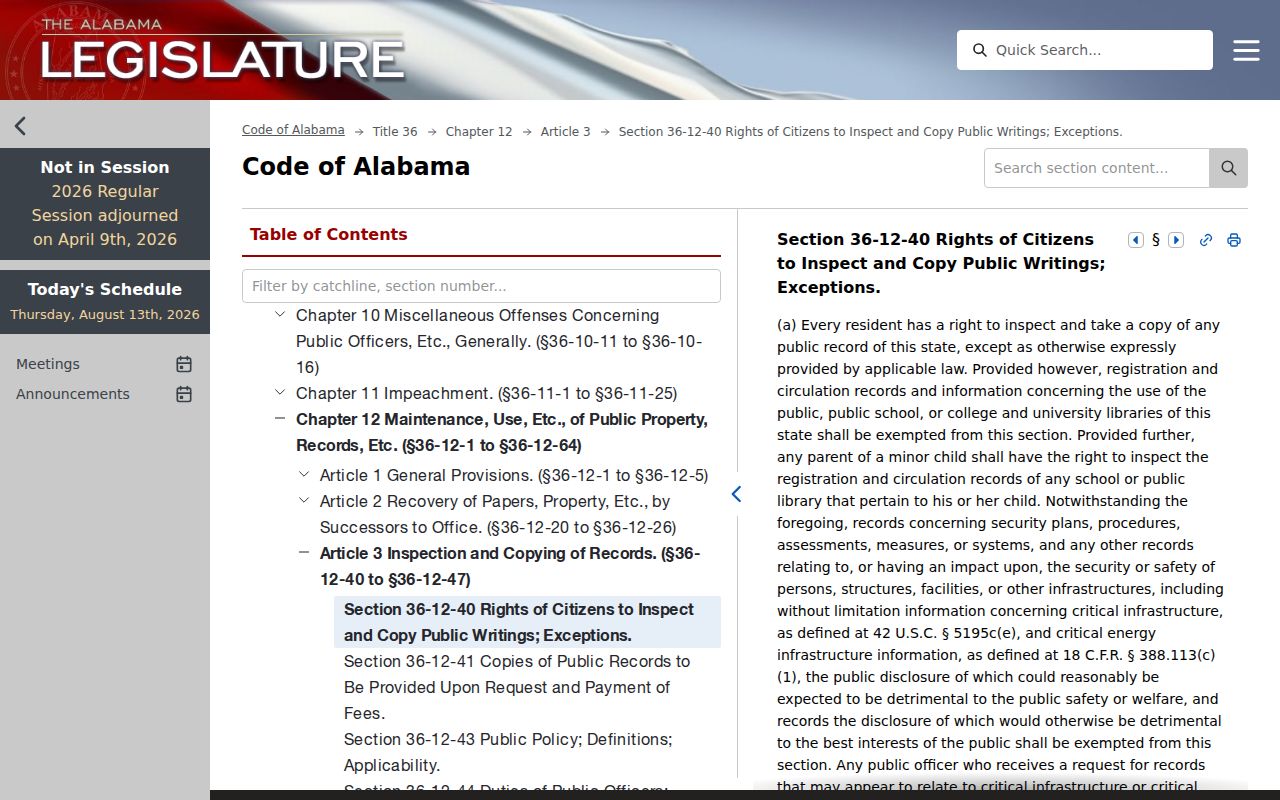
The statute supplies the public-access context. For any single judicial record, the court's privacy rules and orders make the final call on access.
Key access rules:
Alabama Rules of Court-Record Privacy and Confidentiality preserve public access but define confidential and sealed categories.
Rule 30, Alabama Rules of Judicial Administration governs copies, certification, advance payment, and postage.
Rule 5.1, Alabama Rules of Civil Procedure limits display of sensitive identifiers.
Some court records are closed by law. Juvenile, youthful-offender, grand-jury, protected-victim, sealed, and medical files all require lawful eligibility. Or they require a court order. A nonparty who wants a sealed civil record must go through the court process. The clerk cannot hand it over on an ordinary copy request.