
Marshall County Civil Docket Searches
Marshall County posts no free, open web form for a civil name search. Paid options exist instead. Alacourt.com sells subscription access to Alabama trial-court case details and any available images. Just One Look sells single-case access through its Civil or Small Claims category. For a free route, the Guntersville Circuit Clerk's Office offers a public-access computer. You can also call 256-571-7785. Choose option 7 for Circuit Civil or option 8 for District Civil, Evictions, and Small Claims.
If a notice shows the full SJIS case number, use it. Name searches often return several candidates. Narrow by Marshall County, court, category, and filing period where the service allows. AlaFile is the registered filing and service system. It is not a general public docket viewer.
- Identify Small Claims, District Civil, Circuit Civil, or Domestic Relations before searching.
- Use the complete number, or enter a carefully spelled party name and narrow the results.
- Choose Just One Look, Alacourt.com, the free Guntersville terminal, or the clerk phone channel.
- Read service, answers, motions, settings, orders, and judgment from oldest to newest.
- Request the actual filed paper or certified judgment when the summary is not enough.
Note: No official source promises a live refresh interval. Confirm any soon-coming Marshall County civil setting with the assigned division.
Marshall Civil Docket Claim Lines
Current local guidance sorts most civil claims into three bands. Small Claims runs through $6,000. District Civil covers $6,000.01 through $20,000. Circuit Civil generally takes claims above $20,000 plus subject areas assigned there by law. Jurisdiction can overlap or hinge on a specific statute. These amounts help you find a docket, but they do not settle where a new suit belongs.
| Marshall court track | Published amount band | Docket cue |
|---|---|---|
| Small Claims | Through $6,000 | SM |
| District Civil | $6,000.01 through $20,000 | DV |
| Circuit Civil | Generally over $20,000 | CV |
The Marshall County Circuit Civil page supplies the major-case guidance and fee chart.
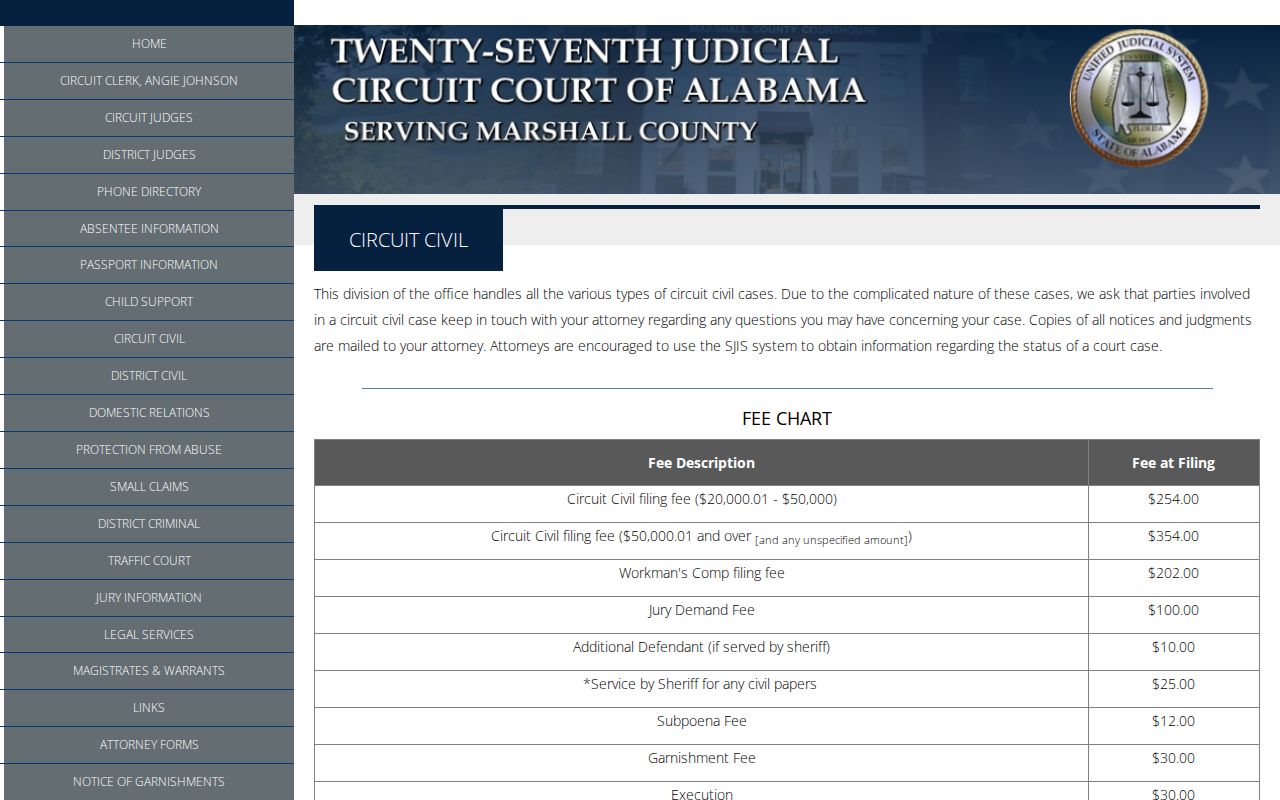
This docket stands apart from the limited civil track. The Marshall County District Civil page spells out the middle band.
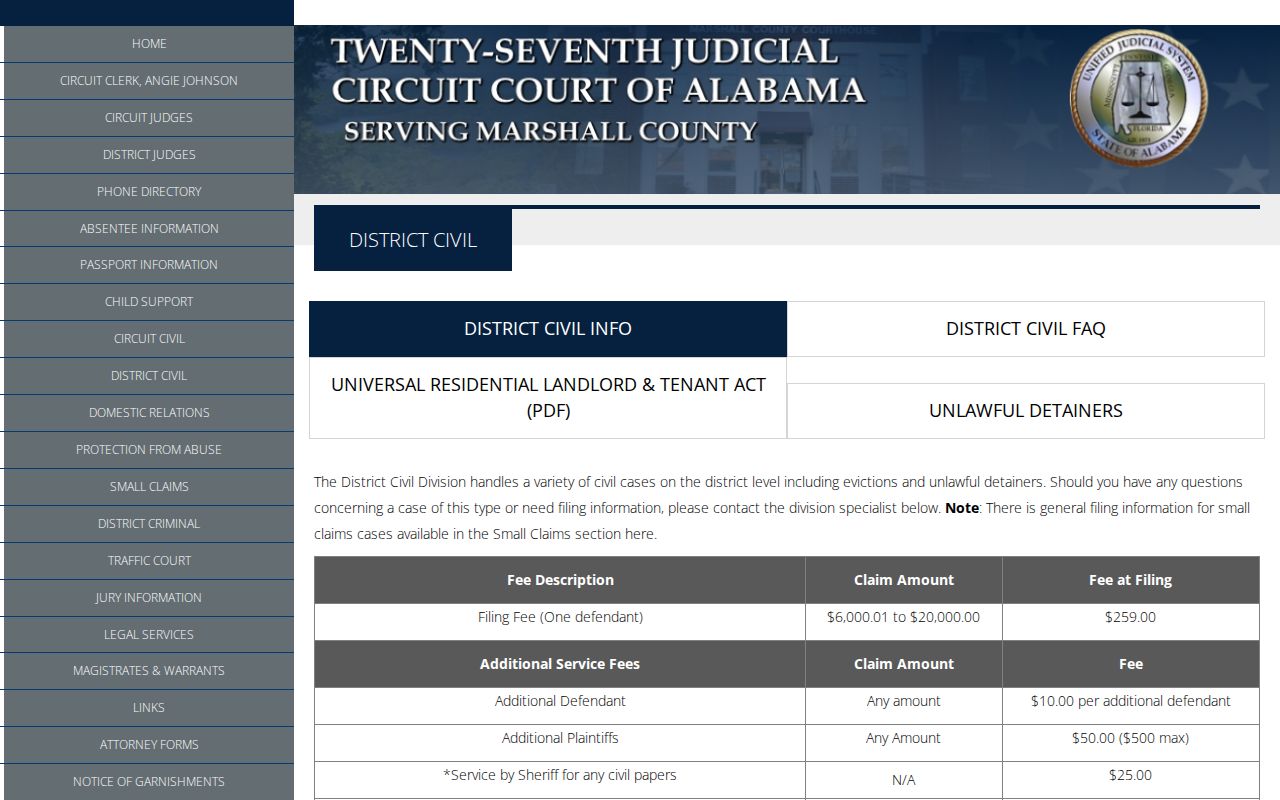
Pair the court with the case prefix, mainly when a matter has been appealed or moved.
Civil Dockets: What They Show
A Marshall County civil docket opens with a header. The header can list the SJIS case number, court, judge, category, filing date, and status. Party roles and lawyers sit in the next layer. The chronological entries track filings in order. They cover the complaint or statement of claim, process and return, answer, motions, notices, settings, orders, and judgment. Collection activity may appear after judgment. Whether document images open depends on the service, your access rights, and state privacy rules.
| Case number | County code 50, category, year, sequence, and extension identify one Marshall case. |
|---|---|
| Parties | Plaintiff and defendant, or petitioner and respondent, are listed by their procedural roles. |
| Service and filings | Process, return, complaint, answer, motion, and other dated action entries. |
| Settings | Trial or hearing dates and any later continuance or reset. |
| Judgment | The formal outcome entry; the signed judgment contains the controlling text. |
The case action summary is the index, a document image is the paper behind one action, and a certified copy is a clerk-authenticated record. Treat the three layers as distinct.
Marshall Civil Docket Case Codes
Marshall is county number 50 in the Alabama SJIS format, so public notices show numbers like 50-CV-2025-900000.00 and 50-SM-2025-900000.00. The two-letter field names the category and the four-digit field is the year, while .00 marks the base case. Related filings can carry later sub-identifiers, and dropping the extension may make a precise docket search fail.
- CV
- Circuit Civil, commonly used for the major civil docket.
- DV
- District Civil, the limited civil court track.
- SM
- Small Claims, the informal District Court civil track.
- DR
- Domestic Relations, including the distinct family-law docket category.
The official Marshall garnishment notice interface shows case-number and document columns without altering the role of the court file.
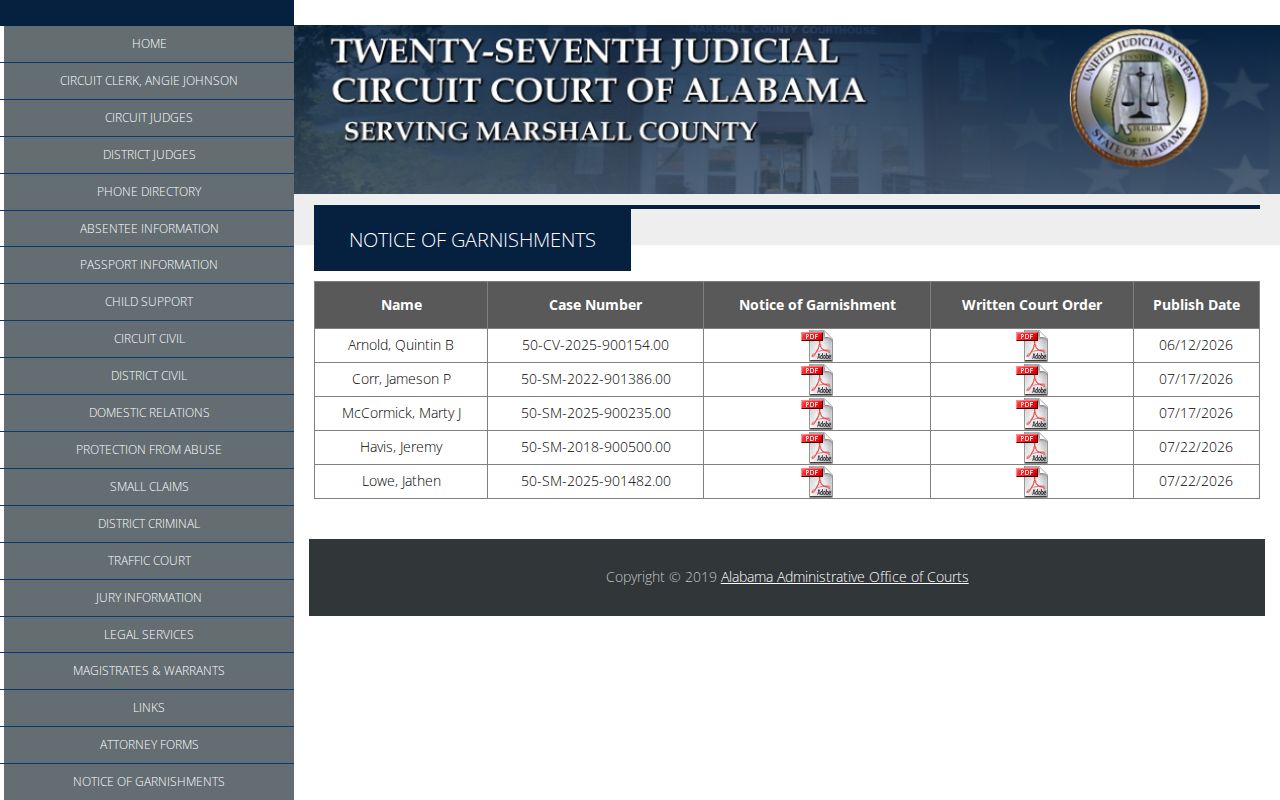
A garnishment entry lands after judgment. It does not reveal the full terms of the judgment before it.
What Cases Fill the Civil Docket
Marshall County civil dockets span several procedures. The right category shapes both the search and the division to call. Small Claims uses an informal bench process. District Civil handles limited claims in its published band. Circuit Civil holds major claims plus other assigned subjects. Domestic Relations keeps its own civil track. After the court rules, postjudgment remedies add new actions to the same case history.
- Small-claims statements of claim and responses within the published limit
- District Civil complaints, service, answers, motions, trials, and judgments
- Circuit Civil claims above the District Court band and assigned subject matters
- Domestic-relations petitions, motions, notices, settings, and orders where public
- Postjudgment garnishment, execution, writ, and certificate-of-judgment events
A filing fee is neither the amount claimed nor the judgment. Marshall publishes a $254 Circuit filing fee. That covers claims from $20,000.01 through $50,000. The fee is $354 above $50,000 or when unspecified. District Civil lists $259 for one defendant in the $6,000.01 through $20,000 band. Those figures are filing costs only. The complaint and judgment state the disputed and awarded amounts.
Marshall Civil Docket Small Claims
Small Claims sits inside Marshall County District Court. The current local maximum is $6,000. The process is built for informal bench proceedings, yet the action list still matters. It can show the statement of claim. It also shows issuance and return of process, response, motions, setting, judgment, and appeal. A request for default and a default judgment are separate events. The request asks for relief. Only the later court entry or order shows whether judgment was entered. The official Marshall County Small Claims page gives the limit, local fees, and appeal period.
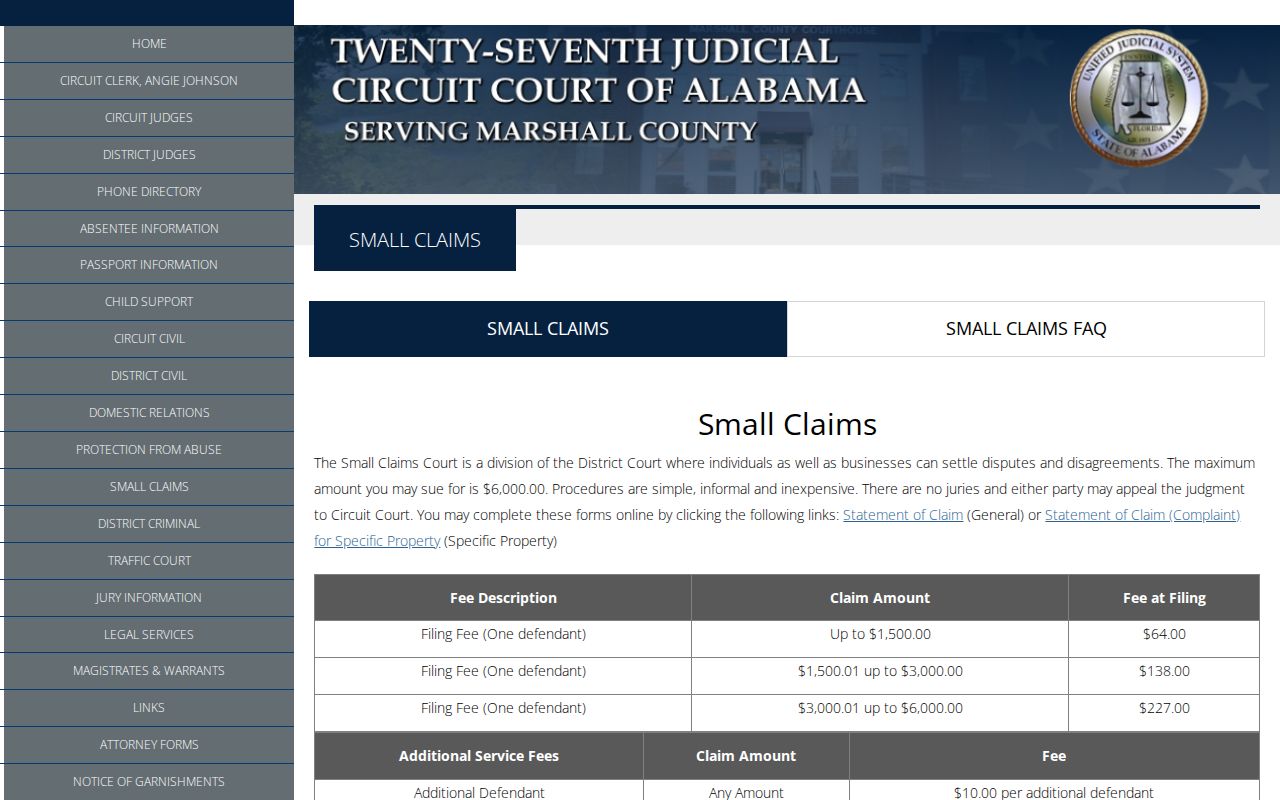
Small Claims losers get a second bite. Under local guidance, a party has 14 calendar days to appeal a Small Claims judgment. The appeal goes to Circuit Court. Once that notice lands, the case can pick up a fresh Circuit setting and new events. So check both places: the original Small Claims record and the Circuit docket now receiving the case.
Note: A default request is just a request. It is not a default judgment. Before calling the outcome, look for the judge's later ruling. Then find the signed order in the court docket.
Hearings on the Civil Docket
Every hearing line deserves a careful read. Pull out the date, time, judge, courtroom, courthouse, and setting type together. Marshall County holds court in both Guntersville and Albertville. So a city name or a party's address won't tell you where to show up. Trust the current notice and the newest docket event over anything older. And a continuance request alone moves nothing. Only an order or reset sets the new date, so hunt for that entry.
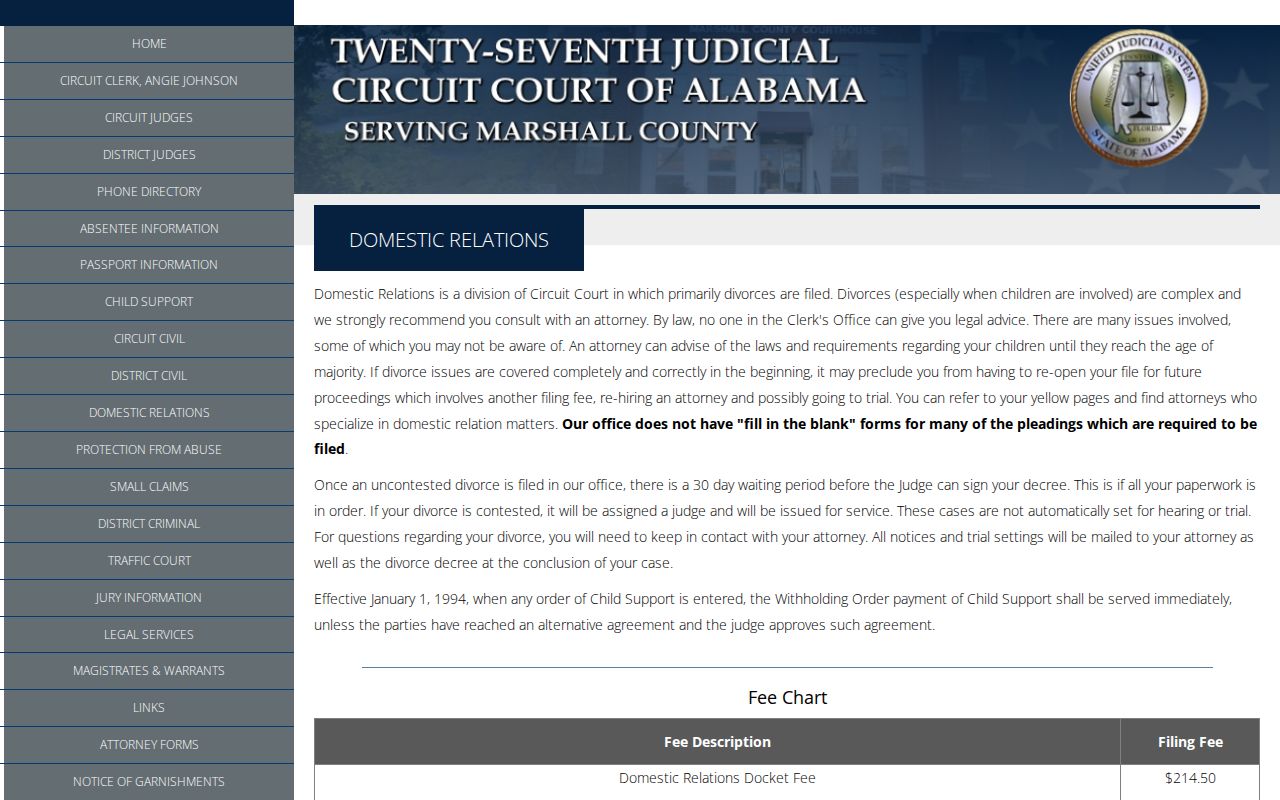
Domestic Relations works a little differently. Cases get assigned to a judge, yet being contested does not automatically earn a setting. Counsel receives the notices and settings. The Marshall County Domestic Relations page spells out how that division runs its calendar.
No notice in the mail? Pick up the phone. Call the right clerk division and ask for the current setting, the courthouse, the courtroom, and whether you must appear. The detailed Marshall County court schedule process helps you tell a requested date from one the court has actually set.
Marshall Civil Docket After Judgment
A civil docket does not go quiet after judgment. Scroll the later history. You may find a postjudgment motion, a notice of appeal, garnishment, execution, a writ of possession, or a certificate of judgment. Each one stands alone as a procedural event. A garnishment entry never restates the full award. And a certificate can't replace the judgment's own text. Read backward through the docket until you reach the order that supports the latest step.
Marshall County's fee schedule lists $30 for garnishment, execution, attachment, or writ of possession, and $50 for a motion for default or summary judgment. Those are clerk filing charges, plain and simple. They say nothing about the balance due in the case. The financial section of a case detail may show assessments and balances, but the court order and the current clerk record still control the result. When a postjudgment line confuses you, request the named motion, return, writ, or order itself instead of guessing from a short docket label.
Who Can See Civil Dockets
Alabama's Rules of Court-Record Privacy and Confidentiality try to balance access against protection. Public inspection and copying are recognized rights. Sealed, confidential, and restricted material stays off limits. Rule 401 lets anyone view electronic District and Circuit court records at the clerk's office at no charge during business hours. It also permits remote subscriber access. Marshall County even advertises a free public computer at the Guntersville Circuit Clerk's Office. One caution: paying for remote access never buys material the law or a court order withholds.
Key access rules:
Alabama Court-Record Privacy Rules govern public, sealed, confidential, and restricted records across court levels.
Rule 5.1, Alabama Rules of Civil Procedure limits displayed Social Security, taxpayer, and account numbers to the last four digits unless an exception applies.
Ala. Code §36-12-40 states the public-writing principle, while court-file requests follow judicial rules and the judicial custodian.
Not everything in a court file is open. Protected identifiers, juvenile material, sealed filings, wholly private family matters, and other confidential records can be hidden in whole or in part. Rule 105 puts the redaction duty on the filer. A routine record request does not override any restriction. Ask the Circuit Clerk what entitlement or court order the category requires.
Marshall Civil Docket Judgment Copies
A case action summary may say judgment was entered without spelling out every term. When the exact wording matters, pin down the judgment or order by its docket date. Alacourt.com or Just One Look may offer an image of the filing. If not, ask the Circuit Clerk for that specific paper. A plain copy just reproduces the document. A certified copy adds the clerk's authentication.
Coming in person? Bring the full case number, court, category, and document title. For mail requests, confirm the current total first. Confirm accepted payment too. Then send those same fields plus your contact details, delivery choice, and return-envelope information. State Rule 30 allows written requests. It requires payment before release and puts postage on the requester. Marshall County posts no dedicated copy-request form, no local turnaround promise, and no separate local certification price, so confirm those details rather than assume them. The clerk can share case-file information and schedules. But the clerk cannot interpret the judgment or tell you what filing should come next.